
Mahjong 4 Friends: Multiplayer
Unwind MediaBoard
4.8424.00 Reviews
- Version
- Varies With Device
- Installs
- 100.00K
- Age Rating
- Everyone
Screenshots
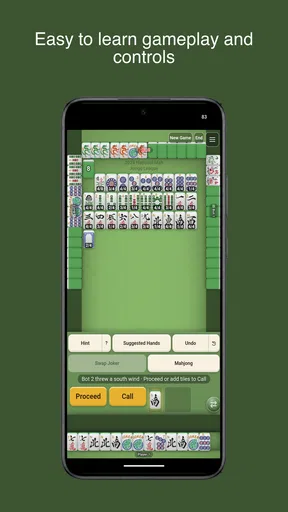
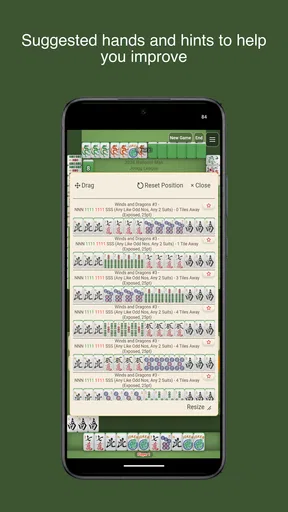
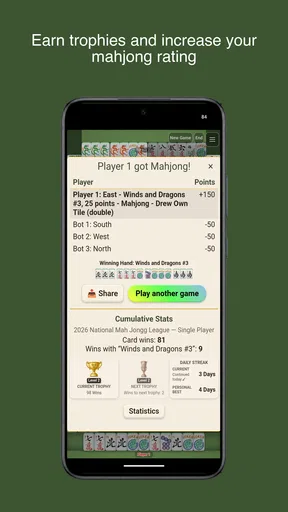
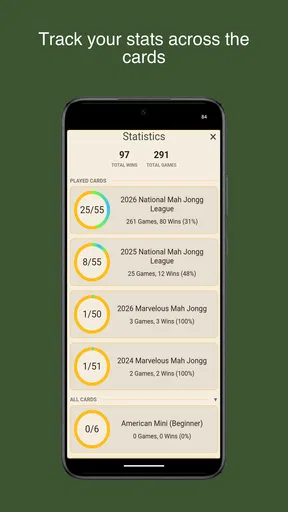
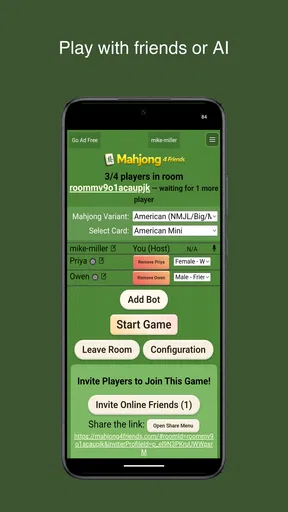
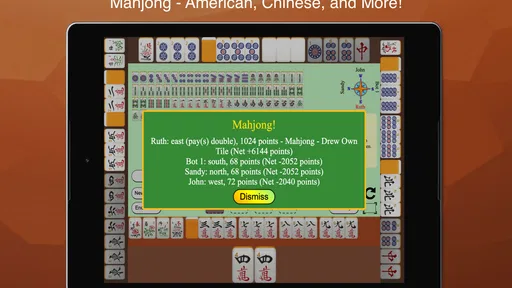
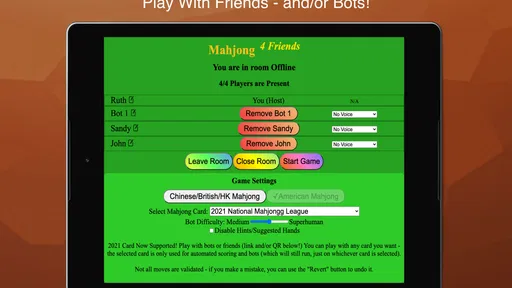
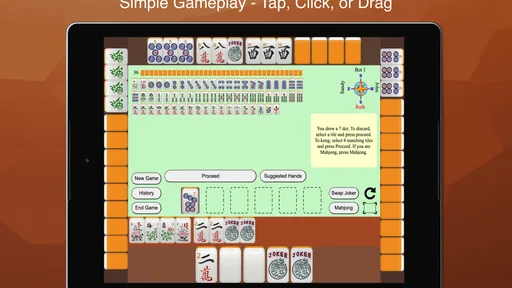
Our Review of Mahjong 4 Friends: Multiplayer
 Analysis by Appyee
Mahjong 4 Friends: Multiplayer is the kind of board game I open when I want a proper table-game feeling without needing everyone to be in the same room. Developed by Unwind Media, it focuses on multiplayer American and Chinese Mahjong, while also allowing play against AI. That combination is the important part: the app is not merely a digital tile puzzle, but a way to keep a Mahjong session going when finding three other players is difficult.
I found the experience most appealing when I treated it as a flexible meeting point rather than a quick solo game. You can play with friends, use AI when a full group is unavailable, and move between the two styles depending on the moment. It is free to install, rated for Everyone, and has built a sizeable audience, with more than one hundred thousand installs and an average rating of 4.8 from roughly 1.8 thousand ratings. Those figures suggest a healthy reception, but the more useful question is whether its multiplayer focus fits the way you actually want to play.
Why the multiplayer focus changes the Mahjong experience
The strongest capability here is the ability to bring American and Chinese Mahjong into the same mobile destination. That matters because people often use “Mahjong” to describe very different games. A tile-matching puzzle is usually a solitary visual exercise, while the traditional table game depends on drawing, discarding, reading opponents, and completing a hand under a particular ruleset. This app belongs much more clearly to the second group.
For me, the difference is felt immediately in the way a session develops. A matching game can be paused and resumed with almost no social consequence. A multiplayer Mahjong table has rhythm: players wait for draws, watch discards, and make decisions that reveal something about their intentions. Even when the app is played casually, that shared structure gives each move more weight than simply clearing a stack of tiles.
The inclusion of both American and Chinese play is also practical for groups with different backgrounds. Someone who learned one form of Mahjong may not want to abandon familiar habits just to join friends who prefer another. Instead of forcing every player into one interpretation, the app makes its appeal broader. I would still recommend agreeing on the preferred style before starting, especially if your group includes beginners who may assume that all Mahjong tables follow the same rules.
This is where the app’s short identity as “Mahjong 4 Friends” makes sense without telling the whole story. The title points toward the social purpose, but the AI option is just as important in everyday use. Without computer opponents, a four-player game becomes fragile: one cancellation can end the plan. With AI available, a player can still practice or fill a session when the group is incomplete.
What a real session feels like
My advice is to approach the first game as a learning table, not as a test of expertise. Mahjong has a lot of visual information packed into every turn, and the difference between American and Chinese play can make the opening session feel busier than expected. I found it more useful to focus on the immediate decision—what to keep, what to discard, and what the current table suggests—rather than trying to memorize every possibility at once.
Playing with friends adds a layer that AI cannot fully replace. Human players create recognizable habits: one person may hold tiles for too long, another may discard aggressively, and someone else may change direction whenever a promising combination appears. Those patterns make repeat sessions more interesting because you are not only building your own hand; you are interpreting the people around you.
AI opponents serve a different purpose. They make the app more dependable for solo practice and remove the pressure of arranging a complete group. I would use them to become comfortable with the flow, test how quickly I can identify useful tiles, and learn from mistakes without making friends wait. That is a more valuable use of computer opponents than treating them as a perfect substitute for human competition.
A useful habit is to separate learning from social play. When I am still unsure about a rule or decision, I prefer an AI session because I can concentrate on the board. Once the basic flow feels natural, playing with friends becomes more enjoyable because I am no longer spending every turn trying to remember what the game expects. This simple division makes the multiplayer feature feel less intimidating.
The best everyday scenario
The clearest use case is a small group that wants to play together but cannot share a physical table. Imagine four friends who have a regular evening call. Instead of trying to explain tile positions through a camera or passing a physical set around one room, each person can participate from their own device. The conversation remains part of the session, while the app handles the board state and turn structure.
There is another realistic situation that I think is just as important: three friends are ready to play, but a fourth person is unavailable. In a physical game, that usually means changing plans or finding a replacement. Here, the AI option keeps the table moving. It does not recreate the jokes or reading of a real fourth player, but it protects the evening from collapsing because of one missing person.
For families, the Everyone content rating makes the game easier to consider for mixed-age play, although the strategic rules may still be more approachable for older children and adults than for very young players. I would introduce it gradually, explaining the goal and turn flow before worrying about advanced decisions. The absence of a frightening or mature presentation helps, but the mental demands of Mahjong remain the real barrier.
It can also work well for players who already own a physical set but do not always have the space or time to arrange it. A physical table offers a richer tactile experience, so I would not claim the app replaces it. What the mobile version does better is convenience: it is ready when the group is scattered, when the table is occupied, or when you want practice without setting up and putting away a full collection of tiles.
Tips that make the multiplayer format easier
First, decide which Mahjong tradition your group wants before anyone becomes invested in a match. American and Chinese Mahjong are not interchangeable labels, and a player who expects one style may interpret the other as confusing or unfair. A short agreement at the beginning prevents the most avoidable source of friction.
Second, use AI as a rehearsal partner rather than only as a fallback. A short practice session can help you recognize the pace of drawing and discarding before you join friends. This is especially useful if you are returning to Mahjong after a long break. You can spend the social game making strategic choices instead of asking what each turn means.
Third, treat the discard area as information, not decoration. New players often stare only at their own tiles, but the multiplayer value comes from noticing what others are willing to release and what they appear to avoid. Even when you are not sure what a particular discard means, tracking the pattern gives you a reasoned basis for your next choice. That is one of the first ways the app becomes more than a digital tile-matching exercise.
Finally, keep the first group session relaxed. If one experienced player dominates the conversation by correcting every move, beginners may stop experimenting. I get more from the app when everyone is allowed to make imperfect decisions and then discuss them afterward. The game is better at teaching through repeated turns than through a long explanation before the first hand.
Where the app is less convincing
The same multiplayer emphasis that makes the app attractive can make it a poor fit for someone seeking a completely quiet, instant game. If your ideal board-game session lasts only a few minutes and requires no coordination, a traditional Mahjong solitaire title will probably feel more convenient. Those games are built around quick individual progress, while this app asks you to engage with a shared match.
It is also not the best choice for someone who wants a physical simulation above all else. A real Mahjong set has weight, sound, and a sense of place that a phone cannot reproduce. The app earns its place through access and flexibility, not through tactile realism. I would choose the mobile version when my opponents are elsewhere or when setup is inconvenient, and the physical set when the group is already together.
Another trade-off is the learning curve created by the two rule traditions. Variety is a strength, but it can also make the experience feel less straightforward than a game built around one simplified ruleset. A newcomer may need patience before the choices become intuitive. That is not a flaw in Mahjong itself, but it does mean the app is better for players willing to learn than for people looking for a purely casual tap-and-clear distraction.
The free price lowers the barrier to trying it, but in-app purchases ranging from $0.99 to $19.99 per item mean that the complete experience may include optional spending. I would begin with the free version and decide whether the available play style suits me before buying anything. The sensible question is not whether a purchase exists, but whether it solves a problem I actually have, such as wanting more flexibility or supporting longer-term use.
Because the game is social, the quality of a session depends partly on the people involved. A thoughtful group can make a close hand exciting, while an impatient or overly competitive group can make the same interface stressful. The app provides the table, but it cannot guarantee good communication between players. If your friends dislike turn-based games or rarely have time to finish a match, the multiplayer capability may remain unused.
Who gets the most from it
I would recommend it most strongly to people who already enjoy Mahjong and want a practical way to play with friends who are not nearby. It is also a good entry point for curious beginners who prefer learning through actual turns instead of reading rules in isolation. The AI option gives them a lower-pressure route into the game, while the multiplayer table provides a reason to keep practicing.
It suits households where different people enjoy different versions of Mahjong as well. The ability to approach American and Chinese play means the app can serve more than one kind of player, although everyone should still establish expectations before a match. That small bit of preparation pays off because it keeps the focus on decisions rather than rule disagreements.
I would be more cautious about recommending it to someone who wants a fast solo pastime, a highly tactile board-game replacement, or a puzzle with almost no explanation. Those players may be happier with Mahjong solitaire, a physical set, or a simpler board game. The app’s value comes from the tension between individual choices and a shared table, so removing the social or strategic part removes much of what makes it worthwhile.
Unwind Media has positioned this as a free board game rather than a premium-only tabletop product, and the response so far is encouraging: it carries a 4.8 average across about 1.8 thousand ratings and has 424 written reviews. It was released on August 4, 2020, and the continued install base shows that the concept has found an audience. I see those details as signs of staying power, though they should not replace your own judgment about whether you enjoy this style of play.
My final take after using its central feature
The real strength is not simply putting Mahjong on a phone; it is keeping a four-player table possible when circumstances would normally break it apart. Friends can play from different places, and AI opponents make practice or incomplete groups viable. That flexibility gives the app a clear purpose, especially for people who value the social side of Mahjong but cannot regularly gather around a physical set.
I like that the game leaves room for both familiar traditions and different levels of commitment. I can use it for a focused practice session, a relaxed evening with friends, or a backup plan when one player is missing. At the same time, I would not pretend that it replaces the atmosphere of a real table or the instant simplicity of a solitaire puzzle. Its learning curve and multiplayer dependence are genuine considerations.
For me, the deciding question is simple: do you want to play Mahjong with people, or merely play something that looks like Mahjong alone? If the answer is the former, Mahjong 4 Friends: Multiplayer is a convincing free option to try. Give yourself time to learn the chosen ruleset, use AI before inviting a group, and treat the app as a bridge between players rather than a substitute for every kind of Mahjong experience.
Verdict
Strengths of Mahjong 4 Friends: Multiplayer
- Supports multiplayer games with friends in real time.
- Classic Mahjong rules are easy to learn and follow.
- Private rooms make casual matches more enjoyable.
- Works well for short gaming sessions on mobile.
- Clean interface keeps the focus on the game board.
Limitations of Mahjong 4 Friends: Multiplayer
- Finding opponents may take time outside peak hours.
- Some features may require in-app purchases or upgrades.
- Online play depends on a stable internet connection.
- The experience can feel repetitive for solo players.
- Ads may interrupt gameplay in the free version.
Similar Picks in This Category
View All
Ludo King®
Gametion4.1

Ludo
Yarsa Games4.6

Tile Master® - Matching Game
Higgs Studio3.6

Checkers Online
CC Games4.6

Dominoes
Loop Games4.7

Chess
Chess Prince4.6
Frequently Asked Questions
What is Mahjong 4 Friends: Multiplayer?
Mahjong 4 Friends: Multiplayer is a digital Mahjong game designed for playing with other people online. It focuses on multiplayer matches, allowing you to challenge friends or join games with other players. The app is aimed at users who enjoy traditional Mahjong rules in a more social format, with the convenience of playing from an Android or iOS device instead of using a physical Mahjong set.
Can I play Mahjong 4 Friends with my friends?
Yes, the main appeal of Mahjong 4 Friends: Multiplayer is its social experience. You can generally create or join multiplayer games and invite friends to participate, depending on the available room and matchmaking options. Before downloading, remember that everyone may need a compatible device, an internet connection, and the same supported version of the app for the smoothest experience.
Do I need an internet connection to play?
An internet connection is normally required for the multiplayer features because the game must connect players and synchronize turns in real time. This means it is best enjoyed over a stable Wi-Fi or mobile data connection. If your connection is weak, you may experience delays, disconnections, or difficulty joining a table. Offline play may be limited or unavailable.
Is Mahjong 4 Friends suitable for beginners?
The game can be suitable for beginners, particularly if you are interested in learning Mahjong through casual matches with friends. However, Mahjong has different regional rules, scoring systems, and terminology, so the experience may feel confusing at first. New players should review any in-game instructions and confirm which rule set is being used before starting a competitive match.
Is Mahjong 4 Friends: Multiplayer free to download and play?
The app may be available as a free download, but the exact experience can depend on the platform, region, and current developer policies. Some free games include advertisements, optional purchases, or other paid features. It is worth checking the Google Play Store or Apple App Store listing before installing to review the current pricing, in-app purchase details, permissions, and supported devices.
Play our best games!


